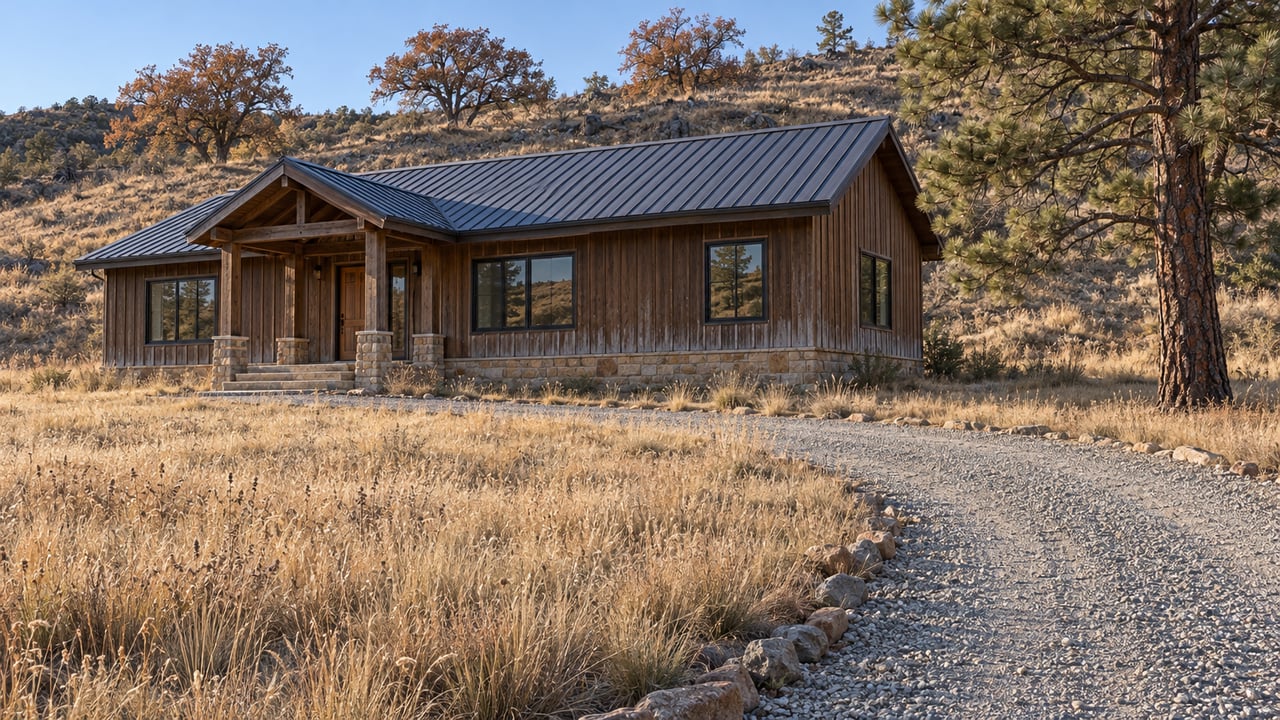
Picture a studio over the detached garage, with its own door, a sink, and a small refrigerator. The state of Colorado's well rules turn on the size of that refrigerator. At 6 cubic feet or less, with a wet bar and no stove, the studio can still count as part of the main house, as long as it also passes the state's tests on who lives there and how its water is used. Add a refrigerator any bigger than that, a stove, an oven, a 240-volt outlet, or a gas line for cooking, and the state counts the same studio as a second single-family dwelling. On a rural La Plata County parcel served by a well, that classification usually settles whether the guest house is allowed. The county's acreage tiers come second.
Buyers looking at acreage outside Durango tend to start with zoning and lot size. The county's rules are fairly generous, and that's the trouble. They can make a property look ready for a second home when its water source says otherwise.
Two rulebooks, drawn on different acreage lines
La Plata County's Land Use Code covers additional dwelling units in Section 73-3, in effect since January 4, 2022. The Colorado Division of Water Resources applies its own thresholds to wells. Side by side, they measure different things:
| Rule | Acreage line | What it governs |
|---|---|---|
| County, shared-utility second unit | No minimum | Director Determination if the unit shares the main home's meter, water source, septic and driveway, and is no larger than the main home or 2,000 sq. ft., whichever is less |
| County, administrative permit | 6 acres | A second unit that doesn't qualify for Director Determination |
| County, agricultural parcels | 30 acres / 45 acres | Second / third unit by Director Determination if the parcel was assessed as agricultural |
| County, no land use permit | 70 acres / 105 acres | Second / third unit |
| State, exempt well | Under 35 acres | In most areas of the state, household use inside one single-family dwelling |
| State, exempt well | 35 acres or more, only well on the parcel | May allow household use inside up to three single-family dwellings |
None of the county's lines falls at 35 acres. On a well-served parcel, though, 35 acres is the line that matters most.
The county's easiest path runs straight into the well
The easiest county route has no minimum acreage. The second unit has to use the same electric meter, the same water source, the same septic system and the same driveway as the main home, and its livable floor area can't exceed the main home's or 2,000 square feet, whichever is less. The county's ADU application says that on parcels under 6 acres, sharing all utilities is required. If the water comes from a well, the county also requires a pump test and a water-quality test.
A shared water source on a typical small rural parcel means one well, and that's where the state's rule takes over. DWR's Guideline 2016-1, amended December 20, 2023, explains that well permits are generally issued with a limit on how many single-family dwellings they can serve. It also sets out how the state decides whether a guest space is part of the main home. A guest space counts as an extension of the main house only if it meets every one of these conditions:
- It isn't rented, leased or occupied by anyone other than guests or family members, or caregivers and similar employees who would otherwise live in the main house.
- It doesn't use water for business purposes or for restrooms open to customers or the public.
- If it's separate from the main living area and has its own entry, it has no kitchen. A kitchen here means a stove or oven, a 240-volt or gas hookup for cooking, or a refrigerator larger than 6 cubic feet.
A space that meets all three can share a well permitted for one dwelling without any change to the permit. A space that misses even one counts as a separate dwelling, and the well permit then has to allow two or more. The guideline adds one more point. If a county's definition of an accessory dwelling unit requires the unit to be rentable or to have a kitchen, the state treats every ADU in that county as a separate dwelling, whatever the owner plans to do with it.
In practice, a guest house the county is willing to approve on a 5-acre parcel may still be one the well permit can't legally serve.
Why 35 acres is the line to price
The state's distinction rests on statute. DWR's well-permitting page says it plainly:
"In most areas of the state, in order for a well on a tract of land less than 35 acres in size to be exempt from administration, statute requires the use of the well to be limited to ordinary household purposes inside one single-family dwelling."
On that same page, DWR says that in most areas of the state, for a well on less than 35 acres to serve two dwellings, it would have to be included in a plan for augmentation decreed by the water court. Short of that, changing the rule would take an act of the legislature. An augmentation plan replaces the water a well consumes so that senior water rights aren't injured. A temporary substitute water supply plan can cover operations while a court case is pending. Those plans are time-limited and have to be renewed.
At 35 acres or more, the picture changes. If the well is the only well on the parcel, its permit may allow household use inside up to three single-family dwellings. If the permit was issued as the only well on a 35-plus-acre parcel but doesn't specify a number of dwellings, DWR says it may be possible to amend it under State Engineer Policy 1993-4. That amendment isn't automatic, and the permit's written conditions control.
Older wells have a rule of their own. A well first put to domestic use before May 8, 1972, that historically served one single-family dwelling can typically be expanded to serve two only through a decreed augmentation plan.
For a buyer comparing two well-served properties, a 34-acre parcel and a 36-acre parcel can look almost identical on a listing sheet. Measured by what their wells can support, they may be very different properties.
The county's 2026 housing work leaves the water rule alone
La Plata County is actively reworking its housing rules. Its long-range planning page describes a review with the Regional Housing Alliance, a December 9, 2025 commissioners' work session, and a countywide housing survey that closed February 23, 2026. Code amendments on reducing process for desired housing types, compatibility criteria and variances are slated for Q4 2026. "ADU Regulations" appear on the schedule for Q3 2027.
The county's July 2026 Land Use Code Audit recommends simplifying Section 73-3. Its examples include reducing the acreage tied to each permit type, allowing more units without a land use permit, or allowing any unit that is deed restricted. It also suggests a new countywide "granny flat" use approved by Director Determination for units that share infrastructure or are deed restricted. The August 17, 2026 draft Housing Framework calls the existing code "more permissive than what many comparable counties allow." It argues that "the real barrier to uptake is cost and return on investment, not process," and recommends financing support, pre-approved plans and an eligibility pre-check.
These are county land-use proposals. They change how the county reviews a second unit. They don't change what a state-issued well permit allows, because the state controls that limit.
The state's 2024 ADU law, HB24-1152, doesn't reach this situation either. The Division of Local Government's list of jurisdictions the law covers doesn't include La Plata County or Durango. DWR also says the law "specifically does not apply to parcels served by a well with a permit that cannot supply an additional dwelling unit."
The county does hold conditional water rights under Cases 06CW99 and 06CW127, which are available for specified uses and locations through a county approval process and, ultimately, a water-court decree. Their eligible uses and places of use are fixed by the decrees. They aren't a general water bank for adding a dwelling to an existing well.
Inside Durango city limits, an ADU goes through the city's own review, with a $350 application fee on the city's fee table effective March 31, 2026. City lots on municipal water don't run into the exempt-well question.
Checking a property before you write an offer
This post is general information, not legal advice. Water rights, well permits and land-use approvals depend on each parcel's own records, and only DWR, La Plata County Planning and a Colorado water attorney can tell you what applies to a specific property. With that in mind, these are the public records worth gathering for a well-served parcel in unincorporated La Plata County, so those conversations start with the right documents:
- Find the actual well permit. DWR's Well Permit Search Tool and Map Viewer let you search by address, applicant name, receipt number or permit number. The well file shows allowed uses, the original application, and construction and pump records.
- Read the permit's conditions. Look for the number of dwellings and any limit on outdoor use. DWR's Guideline 2023-1 describes an exempt well on a non-cluster parcel under 35 acres as limited to ordinary household use inside one single-family dwelling, with no outdoor uses.
- Compare the parcel's acreage with the 35-acre line, and confirm whether this is the only well on the parcel.
- Note how any existing guest space is set up. Write down whether it has a kitchen, a separate entry or a rental history, and bring those details to the professionals reviewing the well permit before closing.
- Talk with La Plata County Planning about the county side. That includes the pump test and water-quality test the county's ADU application requires for well-served units.
Rooftop rainwater collection doesn't get around the state limit either. DWR's rooftop rainwater permits for homes on exempt wells allow collected water to be used only for the uses that well permit already allows.
If you're weighing acreage outside Durango with a guest house or a family unit in mind, I can pull the well file with you and work through it alongside the listing before you commit. Reach out to Judi Mora for that conversation, or request a free home valuation if you're on the selling side and want to know what your own well permit means for buyers.